California Childcare Licensing Regulations in Santa Clara County
Childcare facilities operating in Morgan Hill must comply with health and safety standards mandated by the California Department of Social Services (CDSS) Community Care Licensing Division. To maintain an active license, facilities must employ staff trained in recognized preventive health practices.
California regulations break down required childcare health instruction into three distinct components:
- Pediatric First Aid: Practical management of minor injuries, sudden medical conditions, and physical trauma in pediatric populations.
- Pediatric CPR: Life-support techniques, including infant and child CPR and Automated External Defibrillator (AED) administration.
- Preventive Health and Safety: An 8-hour module focused on environmental health, infectious disease prevention, childhood nutrition, and lead exposure awareness.
While CPR and First Aid prepare caregivers to take action during acute physical emergencies, Preventive Health Practices focus on daily operational safety. The goal is establishing healthy environments that reduce risk before injuries or illnesses occur.
Family Child Care Homes vs. Licensed Child Care Centers
State licensing guidelines establish specific training mandates depending on the type of facility and employee roles:
Family Child Care Homes
For both small and large Family Child Care Homes operating in Santa Clara County, California law requires at least one caregiver who holds current EMSA-approved Pediatric CPR, Pediatric First Aid, and Preventive Health and Safety training to be present at all times when children are receiving care. Furthermore, state mandates dictate that home daycare operators complete a designated 1-hour lead poisoning prevention module within their preventive health training.
Child Care Centers and Preschools
In larger Child Care Centers, infant facilities, and head start programs, center directors and designated teaching staff must satisfy state health training criteria. Having staff members certified in EMSA preventive health practices ensures the center remains compliant during routine inspections by Community Care Licensing analysts.
Because regulations can vary based on facility sizing, employer policies, or regulatory updates, childcare workers should confirm their exact training obligations with their licensing analyst or facility administrator.
What Does the EMSA Preventive Health and Safety Module Cover?
The 8-hour EMSA Preventive Health and Safety Course addresses fundamental aspects of health management within early childhood environments. Rather than focusing solely on theory, the curriculum provides practical procedures for daily implementation.
Infectious Disease Management
Caregivers learn standard sanitation measures to minimize the spread of contagious illnesses. Topics include proper handwashing schedules, diapering sanitation protocols, surface disinfection routines, and guidelines for isolating or excluding sick children to protect the group.
Environmental Health and Facility Safety
Instructors cover methods for identifying physical hazards inside classrooms and on outdoor playgrounds. Participants learn strategies for monitoring indoor air quality, maintaining safe storage for cleaning chemicals, and conducting regular safety sweeps.
Lead Poisoning Prevention
The curriculum features required instruction on lead hazard awareness. Childcare providers examine common environmental exposure risks—such as aging lead paint or contaminated water lines—and learn state-mandated precautions to protect young children from heavy metal exposure.
Childhood Nutrition and Meal Safety
Proper nutrition directly impacts child development and immune health. The course explores balanced meal planning, safe food handling techniques, managing severe food allergies, accommodating diabetic diets, and promoting oral health routines among young children.
Understanding Lead Poisoning Risks in Early Childhood Settings
Lead exposure poses serious developmental hazards to infants and young children, whose growing bodies absorb toxins more readily than adults. In older residential structures and commercial spaces, legacy lead paint, contaminated dust, or deteriorating plumbing fixtures can create unexpected hazards.
During the EMSA Preventive Health and Safety module, early childhood educators learn how lead enters the body and affects neurological growth. The course covers practical prevention steps, such as:
- Identifying potential sources of lead dust near windows, doors, and repainted surfaces.
- Implementing daily wet-wiping protocols to keep floor surfaces and play areas free of contaminated dust.
- Understanding drinking water safety guidelines applicable to childcare settings.
- Recognizing the regulatory steps required when a facility undergoes structural renovations.
Educating caregivers on these preventive steps helps protect children in Morgan Hill and surrounding South County communities from hidden environmental health risks.
Addressing Nutrition, Food Allergies, and Dental Health
Providing safe, nutritious meals is a daily responsibility for early childhood educators. The preventive health curriculum highlights key dietary considerations that childcare providers encounter in home daycares and center environments.
Health Area | Practical Application in Childcare Settings |
Food Allergy Response | Establishing clear procedures for identifying food allergies, preventing cross-contact during food prep, and maintaining emergency action plans. |
Diabetes & Special Diets | Understanding how to support children with specific dietary constraints, metabolic conditions, or specialized nutritional schedules. |
Kitchen Hygiene | Maintaining safe holding temperatures for perishable food, proper sanitizing of kitchen utensils, and preventing cross-contamination. |
Oral Health Practices | Encouraging early dental hygiene habits, understanding the impact of sugary beverages on tooth decay, and promoting daily brushing schedules. |
Serving Morgan Hill and Surrounding South Santa Clara County Communities
Situated along the US-101 corridor in the Santa Clara Valley, Morgan Hill serves as a central hub for surrounding residential and rural communities. Safety Training Seminars offers local access to EMSA-compliant instruction right on Monterey Road:
Safety Training Seminars Morgan Hill Training Center: 17760 Monterey Road, Suite C-3, Morgan Hill, CA 95037
This location offers convenient access for early childhood educators, preschool teachers, and home daycare operators coming from nearby South County and San Benito County areas, including:
- Gilroy (located directly south via US-101 or Monterey Road)
- San Martin (situated between Morgan Hill and Gilroy along the Monterey corridor)
- San Jose (specifically South San Jose neighborhoods like Blossom Valley and Santa Teresa)
- Hollister (accessible via Highway 25 connecting to US-101)
- Coyote Valley (located just north along the Monterey Highway)
Childcare professionals working near local educational institutions—such as Gavilan College in nearby Gilroy or local Morgan Hill Unified School District early learning programs—can easily reach this training facility to complete their certification.
Who Should Enroll in the Morgan Hill EMSA Health Course?
The Preventive Health and Safety module is tailored to meet the needs of diverse early childhood workers across Santa Clara County:
- Family Daycare Applicants: Individuals establishing a new licensed home childcare facility who need to fulfill initial state licensing requirements.
- Preschool Teachers & Center Staff: Educators working in licensed Child Care Centers needing compliant certification for facility compliance files.
- Nannies & Private Household Caregivers: In-home childcare specialists seeking recognized health and safety credentials to enhance their qualifications.
- Child Development Students: College students pursuing Early Childhood Education (ECE) degrees who want to complete required health certifications prior to entering the workforce.
- After-School Program Staff: Youth program coordinators and facility staff responsible for maintaining safe environments for school-aged children.
Guidelines Before Registering for Your Class
To ensure your training experience goes smoothly, keep the following considerations in mind when planning your course schedule:
- Confirm Your Specific Requirements: Review your facility’s licensing paperwork or check with your Community Care Licensing analyst to verify whether you need the 8-hour Preventive Health course, Pediatric CPR and First Aid, or all three.
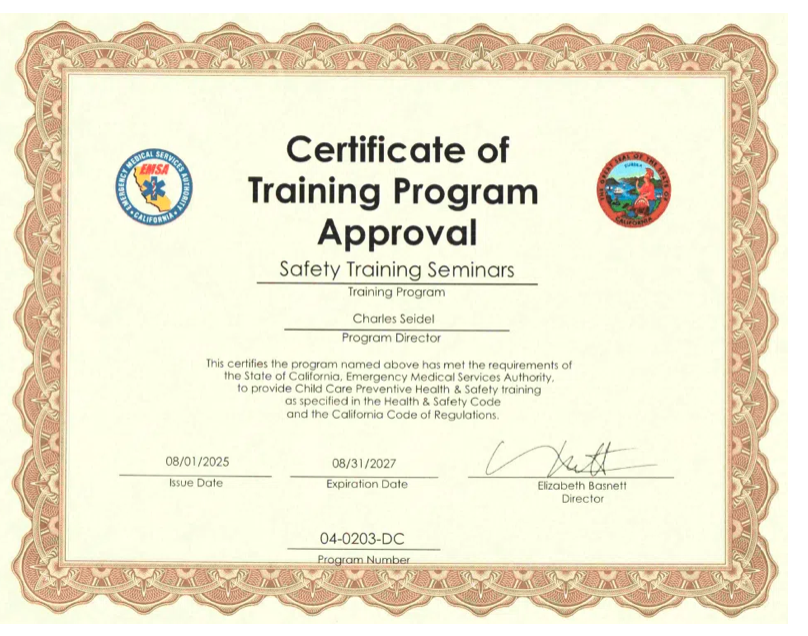
- Verify Official EMSA Approval: State regulations require that certificates carry official EMSA stickers to be accepted by licensing analysts. Safety Training Seminars provides official EMSA documentation upon successfully completing the course.
- Check Class Timings: Plan to arrive at the Monterey Road classroom a few minutes early to register and receive your course materials. Complete attendance for the full session duration is required to receive certification.
Complete Your EMSA Childcare Health Certification in Morgan Hill
Meeting California’s childcare licensing standards ensures that local daycares and preschools remain safe environments for children to learn and grow. Safety Training Seminars provides accessible, state-accepted EMSA Preventive Health and Safety training right in South Santa Clara County.
To view current course availability, check upcoming dates, or secure your seat at the Morgan Hill classroom (17760 Monterey Road, Suite C-3), visit the official Safety Training Seminars registration portal today.